
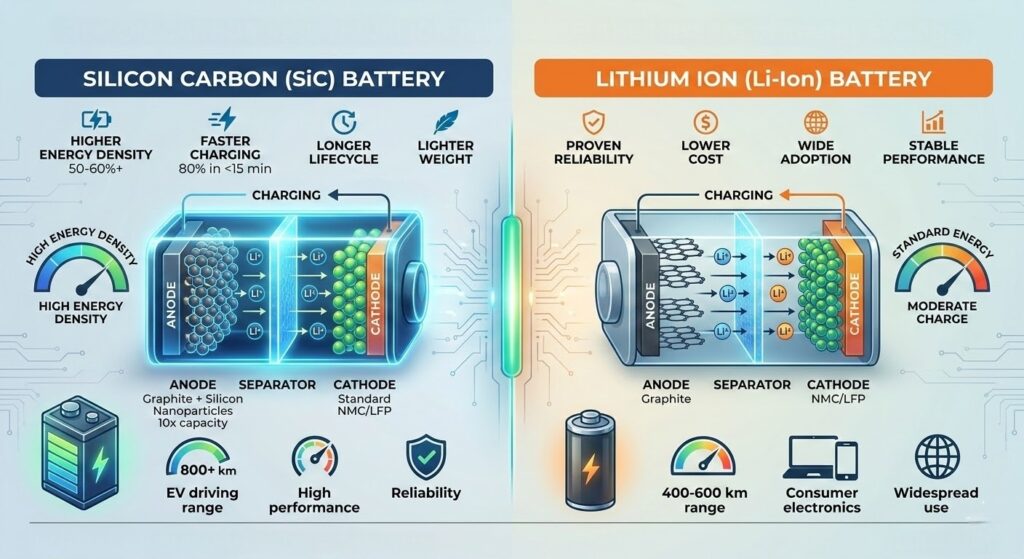
The discussion about Silicon Carbon Battery and Lithium Ion Battery has gained greater importance because smartphones and electric vehicles and portable electronics need batteries that perform at higher standards. For many years, lithium-ion batteries have dominated the market because their users trust their operating performance and their power consumption efficiency. The development of silicon-carbon batteries brings a new technology that provides higher energy capacity and faster charging and extended battery operation time compared to existing solutions.
The distinction between these two battery technologies enables consumers and tech enthusiasts and industry professionals to understand the future direction of battery advancements. The article will examine the functioning principles of silicon-carbon batteries which operate differently from traditional lithium-ion batteries to determine which technology will power upcoming devices.
What is a Lithium Ion Battery?
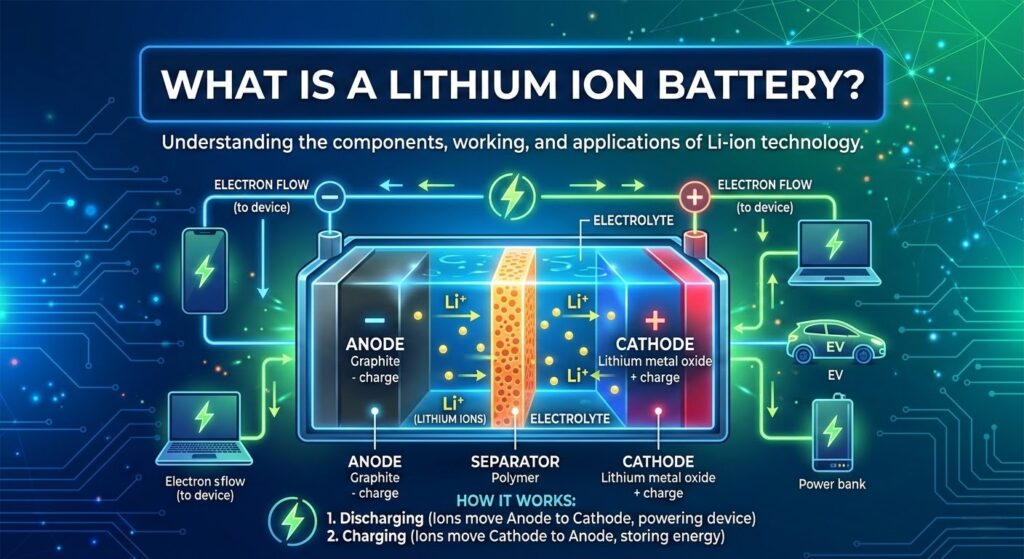
Current market share, over 75 percent of the world’s rechargeable batteries, are lithium-ion batteries. These batteries are powering our smart phones, laptops, tablets, electric vehicles and most other battery operated consumer products.
The reasons for the popularity of lithium-ion batteries are the balance between an excellent energy density, long lifecycle, and good safety.
Lithium-ion batteries function by moving lithium ions back and forth between the anode and cathode through the electrolyte within the cell. When charging / recharging, lithium moves from the cathode to the anode, and during discharge, they move from the anode back to the cathode to create electricity that will power your device.
Most lithium-ion batteries are designed with graphite anodes. Graphite has been an excellent choice of material for being stable and reliable, however, it does have limitations on how much lithium can be stored. Consequently, limitations on the amount of lithium that can be combined with the surface area of the graphite to make the anode naturally limits how much of a capacity or energy density battery can provide.
Some common characteristics found within lithium-ion batteries are as follows:
- High energy efficiency
- Long cycle life
- Lightweight design
- Wide usage in electronics and EVsHowever, despite these benefits, lithium-ion batteries face challenges such as limited energy density, slow charging in some cases, and gradual capacity degradation over time.
What is a Silicon Carbon Battery?
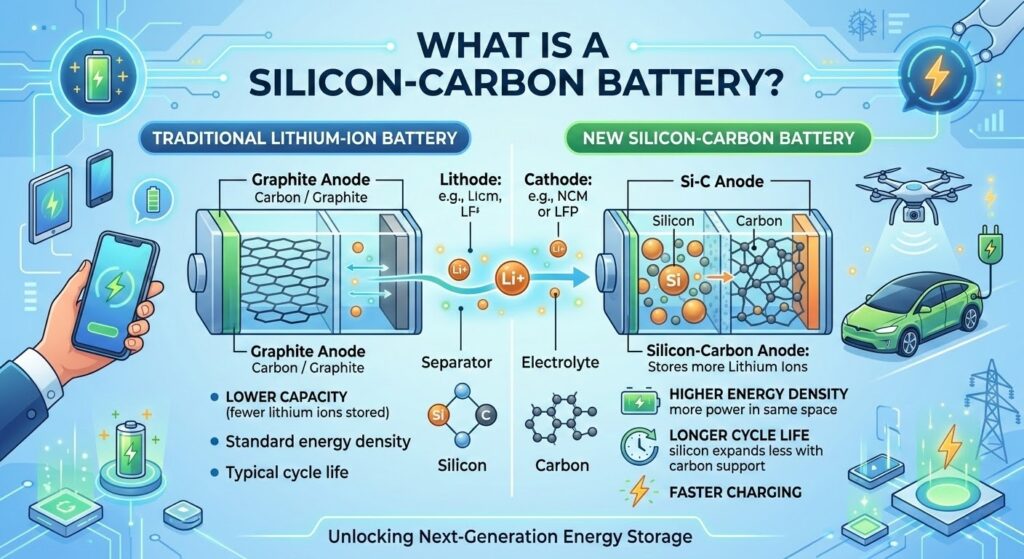
Silicon-carbon batteries are essentially a sophisticated form of lithium batteries. Instead of using a graphite anode as most batteries do, these ones rely on a silicon-carbon composite anode. Since silicon is capable of accommodating many more lithium ions than graphite, this contributes to a higher energy capacity of the battery.
Structurally, silicon-carbon batteries are designed in such a way that silicon is mixed with carbon for the purpose of keeping the silicon’s lattice intact during the battery charging and discharging processes. The problem with pure silicon is that it swells quite a lot when it lithiates, and this phenomenon can lead to the destruction of the battery. The addition of carbon is a way of limiting the swelling effect and at the same time enhancing the clarity of the construction.
Thanks to this composition, silicon-carbon batteries may be capable of producing more energy storage without sacrificing their lifespan. The talk about this kind of battery in the handset industry is getting louder day by day and it is very possible that it will be the main item for electric cars and other storage of power devices in the not too distant future.
Among the benefits of silicon-carbon batteries are:
- Higher energy density than standard lithium-ion batteries
- Potential for longer battery life
- Faster charging capability
- Improved performance in compact devicesThis innovation is one of the most promising developments in modern battery technology.
Silicon Carbon Battery vs Lithium Ion Battery: Key Differences
When discussing Silicon Carbon Battery vs Lithium Ion Battery, many things help us find out which technology is better suited for a particular use. Some of these are energy density, time of charging, life span, safety, and price.
Energy Density
Energy density means how much energy a battery is capable of storing according to its volume or weight.
Silicon-carbon batteries are way ahead in this aspect. Silicon, as a material, can accommodate a number of lithium ions that is up to ten times higher than the amount that graphite can hold. This fact substantially increases the battery’s capacity for storage.
On the contrary, lithium-ion batteries having graphitic anodes are confined by the relatively lower lithium storage capacity of the material.
Charging Speed
It is not uncommon for silicon-carbon batteries to allow for higher charging rates. Since their structure better supports the flow of lithium ions, the rate at which energy can be transferred to the battery during charging is much faster.
Lithium-ion batteries can, obviously, be charged rapidly too; but, because of their limits, they sometimes need to be charged at a slower rate to avoid the risk of overheating and degradation.
Battery Life and Durability
Conventional lithium-ion batteries are famous for having a very long cycle life and for being very stable in their performance. The associated technology has been immensely worked on for several decades and is quite dependable now.
Silicon-carbon batteries are the new kids on the block and are still undergoing development. Besides giving better capacity, handling silicon expansion is a problem that companies are always trying to make better.
Weight and Size
When it comes to portable gadgets such as smartphones and wearables, it is vital to have tiny batteries with high capacity. Having more energy storage ability in the same volume is a feature of silicon-carbon batteries which, for this reason, are very suitable for miniaturized devices.
Cost and Production
At present, lithium-ion batteries have lower prices partly because the manufacturing facilities to make them are already spread all over the world.
Since silicon-carbon batteries involve complex materials and have less established production techniques, it is likely that they will be more expensive initially. Of course, at the moment, the technical advancements and economies of scale will drive prices down eventually.
Advantages of Silicon Carbon Batteries
Silicon Carbon technologies offer many improvements that can greatly change the way batteries are made and how they perform in the future.
Increased Capacity: The primary benefit of this new technology is that it will allow for larger amounts of electricity to be stored (an increase in capacity). Consequently, the result will be longer use time for our phones, computers, and other portable electronic devices.
Faster Charging: Increasingly, consumers are looking for fast charge times when they are waiting to charge their devices. Silicon-carbon battery technologies will support a more efficient charge time due to increased charging speeds.
Smaller Form Factor: The capacity increase will, in turn, allow manufacturers to design devices that are slimmer and are still able to use the more efficient silicon-carbon-based products.
Future Limitation: Over time and with continued investment in research, silicon-carbon technologies can also be expected to significantly enhance the range of electric vehicles and will store energy produced from green energy sources more efficiently.
Advantages of Lithium Ion Batteries
Lithium-ion battery technologies have been developed over many years and generally are very dependable and commonly used.
Long History: The long-time experience of manufacturing lithium-ion batteries has produced a very sophisticated manufacturing process that has been consistently improved.
Lower Price: Since the lithium-ion manufacturing process is well understood, the cost of lithium-ion batteries has fallen over time.
Proven Safety: Battery manufacturers have been researching and improving lithium-ion battery safety (thermal and battery management systems) for many years.
Widely Accepted: Lithium-ion batteries are used in a wide range of products including electric vehicles, laptops, tablets, smartphones, power tools, etc.
Which Battery Technology is Better?
Evaluating the benefit of using Silicon Carbon Battery versus the Lithium Ion Battery depends on what it will be used for. In today’s devices, lithium-ion batteries remain the standard because they have proven to be reliable, cost-effective, and able to be supplied through extensive supply chains.
However, silicon carbon batteries are the next generation of batteries. They provide greater energy density and allow for faster charging; therefore, they could some day change how portable electronic devices and electric vehicles are powered.
As research results in improved silicon stability and reduced production cost, silicon carbon batteries will gradually displace graphite based lithium ion batteries in many applications.
Future of Battery Technology
Battery development plays an important role in industrial sectors such as consumer electronics, solar power generation, and transportation. The advances made by the use of silicon and carbon together represent only one stage in improving the way energy is stored.
Other energy storage technologies being evaluated include solid-state batteries (at least from an R&D perspective), lithium-sulfur batteries, and sodium-ion batteries. All of these types of batteries are aimed at improvements regarding energy density, scaling of battery performance (safety) and increasing the sustainability of energy storage (lifecycle).
There will be a delay before a transition takes place from traditional lithium-ion batteries. The future will see a combination between lithium-ion battery and silicon battery hybrids where a gradual increase of silicon will exist in the existing lithium-ion batteries in order to improve overall performance.
Conclusion
When comparing the silicon-carbon battery to the lithium-ion battery it shows how battery technology is changing to meet today’s energy needs. The lithium-ion battery has served as the power source for digital technology over the last several years due to its low cost, high reliability and proven performance.
Silicon-carbon batteries offer some exciting enhancements over lithium-ion batteries such as higher energy density, increased charging speed and greater space efficiency. Although there are still some technical issues that need to be worked out, these advances represent a great leap forward in energy storage technology.
With continued advances in battery technology, we can anticipate increased battery performance, efficiency and effectiveness in supporting the new generation of smart devices and electric vehicles.
FAQs
What is the main difference between Silicon Carbon Battery vs Lithium Ion Battery?
The main difference lies in the anode material. Silicon-carbon batteries use a silicon-carbon composite anode, while traditional lithium-ion batteries typically use graphite. This allows silicon-carbon batteries to store more energy.
Are silicon-carbon batteries better than lithium-ion batteries?
Silicon-carbon batteries have higher energy density and potential for faster charging. However, lithium-ion batteries are currently more reliable and widely used.
Will silicon-carbon batteries replace lithium-ion batteries?
Not immediately. Lithium-ion batteries will remain dominant for years, but silicon-carbon technology may gradually become more common as manufacturing improves.