
Table of Contents
Do you remember when everyone thought that 5G would change our phones overnight?
Nope, none of that happened. In fact:
You couldn’t even leave 5G on because your battery wouldn’t last. There weren’t many places with a 5G signal. And a lot of the “5G phones” people had were really on a slower version of the 5G network.
So when you hear about “6G”, it would make sense if you thought it was just a fast version of 5G and didn’t feel like it would have an impact.
The 6G is not just a faster version of the 4th generation or 5th Generation networks). 6G is a radical different type of network as compared to 4G or 5G networks. The likes of (Qualcomm’s) are planning (and building) completely new networks from the ground up and will allow you to do incredible things that your phone right now cannot do.
Let’s put it all into perspective and talk in non-technical, no hype, just the real deal.
First, Let’s Be Honest About 5G
Before we get too excited by the upcoming developments in 6G let’s take a moment to understand how people were disappointed with the hype around 5G prior to its full-scale deployment.
The expectation was for ultra-fast download and upload speeds with zero latency, along with everything being seamlessly connected in a single ecosystem. Instead, we have had a continual rollout of touch-based technologies with network variations making it impossible for most users. Case in point is the new “5GE” label being used to market LTE devices as if they were recently deployed 5G capable. Finally users typically disable 5G capability in smartphones due to battery drain when using 5G.
Why 5G Never Really Lived Up to the Hype
The primary issue with 5G appears to be the level of speed you experience based on where you are located. If you think about it, 5G is extremely fast as long as you are in a location that has been built for 5G. Unfortunately, most of the world will not have access to 5G by 2024, and we are still seeing telecom companies shut down their 3G networks in order to focus on the rollout of 5G.
What does this teach us? It teaches us that there is almost always a larger gap than what you see in a headline between what a technology promises and how it ends up working in the real world.
With that in mind, we will begin to talk about 6G; however, we should also note that the jump from 4G to 5G will be much larger than we experienced when making the jump from 4G to 5G.
So… What Exactly Is 6G?
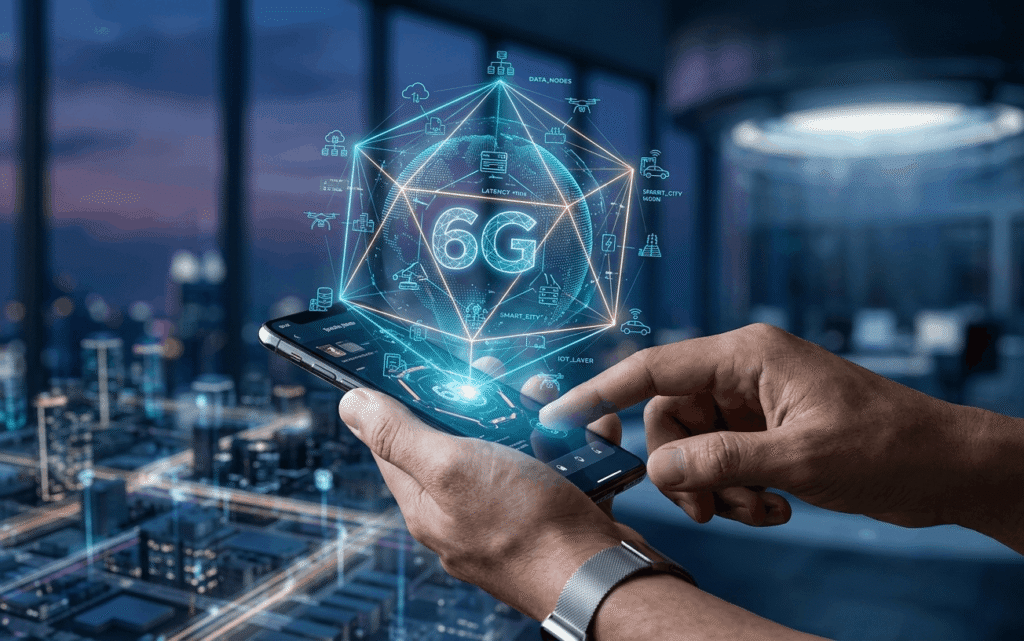
6G technology is the next generation of mobile communications. It is being developed by IMT-2030, a group formed by ITU-R, which is responsible for creating a global plan for 21st century mobile networks.
The major world telecommunications companies, such as Samsung, Nokia, Ericsson, Qualcomm, Huawei and Apple, are heavy into researching this new technology. Unlike all previous upgrades to telecommunications networks that have been about providing faster speeds, the development of 6G networks will be based on using Artificial Intelligence as a fundamental part of their operation.
In addition to transmitting data between devices and locations, 6G networks will also learn and modify how they work dynamically during their operation.
When Is 6G Actually Coming?
So, it’s time to stop speculating and refer to undeniably factual information.
THE DEFINITIVE TIMELINE (NO MORE GUESSES, JUST FACTS)
- Mid-2025: Development work on actual 6G complete: A 21- Month Study Phase to Evaluate Technical Options for 6G Technology.
- June 2026: 3GPP Finalizing the scope/schedule of “Release 21” Phase of 6G.
- End of 2028: Ericsson & Nokia expect technical specifications will be completely defined.
- Summer 2028: NTIA will showcase “live” demonstration of 6G technology at the Los Angeles 2028 Summer Olympics.
- 2030: Commercially available 6G Networks/Smartphones are anticipated to be available WORLD WIDE.
According to Qualcomm, PRE-COMMERCIAL 6G devices may be available by 2028 (however they would only be “test” type devices, not available in retail).
Long Story Short: Do NOT purchase a NEW phone to utilize 6G at this time, but if you are purchasing a Flagship device in late 2029 or early 2030, you will have 6G capability referenced on the specifications.
What Will a 6G Smartphone Actually Do?
This is where it gets really interesting! 6G will not only allow you to download Netflix faster but will also provide many new use cases that seem more like an episode of ‘Star Wars’ than simply upgrading your cell phone.
1. Holographic Phone Calls – Like ‘Star Wars’, but for Real!
You remember that famous scene in “Star Wars” where R2-D2 projects a hologram of Princess Leia? Well, with 6G, that is what video calls could look like every day.
With the data rates necessary for high-definition, real-time holographic communications being so much higher than what 5G can currently deliver, you will be able to see realistic 3D holograms of each other at meetings and medical appointments, as well as when you are just catching up with family.
There will no longer be a need for a headset; just your phone and something to project it on to.
2. AI That Lives Inside the Network
The way AI is incorporated within 5G versus 6G is one of the fundamental differences between the two generations of wireless telecommunications.
With the 5th Generation, AI is treated as a separate component that has been added onto the already pre-existing 5G infrastructure to provide assistance in optimization of certain elements of the communications system. The 6th Generation has been developed from the ground up to include and/or incorporate AI into each component of the communications system structure. For this reason, 6G will be considered to be the first “AI-native” telecommunication system.
Here are a few of the ways AI will be used within the 6G platform to help optimize communications:
- The telecommunications system will be able to automatically optimize itself based on the number of users within your geographical location.
- Your smartphone will be able to offload complex computations to the AI-enabled processing function of the telecommunications infrastructure.
- You will be able to use 6G technology during crowded events without concern for quality of service as a consequence of large number of people in the area (e.g., no more getting only 2 bars of service during a concert).
3. Your Phone Becomes a Health Monitor
Although it may sound crazy, prototypes for this have already begun developing.
Since 6G encompasses communication as well as sensing, your phone will actually track biometrics when you are sleeping. For example, if it tracks inclement breathing patterns, it will alert your doctor of the problem. Your phone will become a passive medical monitoring device – additionally, you won’t require any sort of wearable.
Vivo, for example, is already developing 6G prototypes with this intention in mind.
4. Autonomous Cars Finally Work Properly
Cars that drive themselves have to make decisions about life and death within split seconds. These vehicles need to “see” everything surrounding them, including other vehicles/people and road conditions, and then rapidly process all of the information they’ve “seen” to make quick, accurate decisions.
While 5G provides a 1 millisecond latency time, 6G is predicted to provide a staggering 0.1 millisecond latency time along with much higher capacity for devices per square mile, so truly safe autonomous driving might soon become a reality. Many believe that 6G will ultimately make it possible for millions of people around the world to drive completely autonomous vehicles – and that your mobile device will be part of that connected ecosystem.
5. XR and the Metaverse Actually Become Usable
Massive quantities of data are required to be transmitted at near real-time for VR, AR, and MR to work correctly, but today’s network infrastructures produce glitches and can even induce motion sickness for many users due to the way they currently operate.
With the introduction of 6G technology, the landscape for extended reality (XR) could be changed significantly. The experience of using AR glasses to see an integrated virtual or digital experience with the environment, or using VR for entertainment or other purposes will potentially have no noticeable delay between the user’s physical and virtual experiences.
Who’s Working on 6G Right Now?
The global competition for 6G connectivity is already beginning. Who is participating? Here are the major participants:
- Samsung – Was an early player to publish a white paper on 6G in 2020, with plans to produce commercial products by 2028.
- Qualcomm – Aims to create the first commercial chips for 6G by 2028 and is currently designing and developing the chip architectures.
- Nokia Bell Labs – Has a target of commercial 6G deployment around the year 2030, and expects to have specifications completed by 2028.
- Ericsson – Contributes to developing the 3GPP Release 21 standard.
- Huawei – Has stated their 6G research is aimed to improve energy efficiency up to 100 times more than 5G.
- China – Launched the first 6G satellite test in orbit in 2024, and completed the first transmissions in THz frequency bands on low-Earth-orbit equipment.
- U.S. Government – Issued a joint statement to agree on creating a common 6G standard with nine other countries in early 2024.
The global race to create 6G technology is not just a technology issue; it is also a geopolitical issue.
Will You Need to Buy a New Phone?
In the future, yes, but not for a long time.
6G will require brand-new hardware, just like 5G. This includes new chips and antennas designed specifically for terahertz bands. You cannot upgrade your current iPhone or Android to work with 6G via software update.
The good news is, by the time 6G is widely available (likely 2031-2033), you will probably have a great need for a new device. Smartphone manufactures will most likely also build in appealing features associated with 6G to ensure that the transition to the new network is worth it.
The Bottom Line
6G is a progress from 5G in both speed and capability, so while 5G will give us faster mobile data networks, 6G will provide us with an entirely new level of mobile network service. 6G will also benefit from a wide variety of new technologies, including artificial intelligence (AI).
The timeline is indeed realistic: various companies are currently developing technology related to 6G; specifications for the technology will be published in 2028; and commercial deployment of the technology will happen in about 2030.
There is real hype associated with 6G — in fact, 6G’s underlying technologies are actually intended to solve many of the problems that 5G was unable to address — but compared to 5G, 6G has a much smaller gap between its promises and the reality.