
Table of Contents
Have you ever told a chatbot “Take care of it, okay?” only to receive three more follow-up queries, a FAQ page link, and a sense of having wasted time?
Yes. That kind of response definitely does not qualify Al as an agent. It is just a chatbot with an agent look.
We usually treat the concepts as if they are synonyms. In some cases, one word is a replacement of the other, whereas, generally, they are not. Besides, if you are deciding amongst building, purchasing or automation tools that is a major question, the difference is quite subtle, but quite important.
Quick Answer: The One-Line Difference
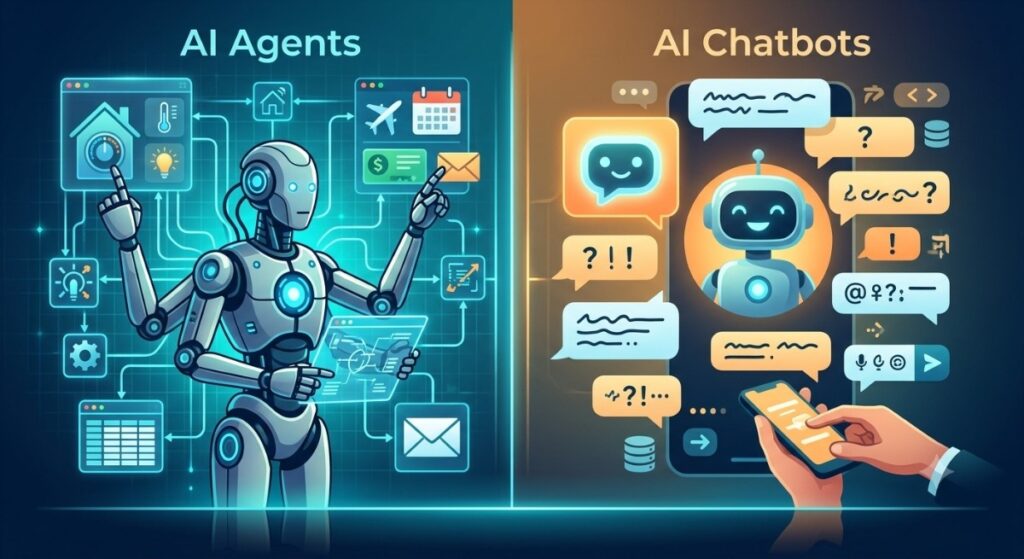
A chatbot communicates. A virtual assistant operates and makes things happen.
A chatbot provides you with an answer. An intelligent assistant executes on the task — books a flight, makes changes in the spreadsheet, completes the ticketing process, finds the information — without you needing to guide it through the entire process.
That’s the main point. All the rest is just details. Yet, it is the details that are fascinating.
What Is an AI Chatbot, Really?
The most recent customer service chat window utilized by you should come to your mind. It reads the keywords “where’s my order” and gets you the tracking link, instantly.
This is what the ultimate purpose of the chatbot is.
How chatbots actually work under the hood
Most chatbots, even the “AI-enabled” ones, essentially use the same loop: input reading, matching that input to an intent, and sending out prep-crafted answers. Some use rules (if this, then that), others work according to natural language processing. In any case, however, they are all reactionary operations. They wait for you to say something and then give the reply.
They do not remember anything outside of the ongoing conversation. They do not act beyond the chatbot. They do not think at all.
Where chatbots shine
This shouldn’t be construed as criticism of chatbots. They are incredibly effective at narrow and routine jobs.
- They can help answer questions within seconds, around the clock
- They can assist in performing simple tasks (password reset, order status)
- They can pre-qualify the lead for a manager
- They can spare people the necessity to hire extra personnel to manage their tickets
In case the task is simple and well defined, robot can often be quicker and cheaper option.
What Is an AI Agent, Really?
Imagine this instead: you tell a computer, “give me a sales report for next week,” and the computer checks out your CRM system to get all your numbers, create charts and a summary, and put it in your inbox – without you ever telling it how to do things.
This is the first sign of something that we can call “an agent”.
There are three aspects that make it agentic
AI agents are usually based on large language models too, but what distinguishes them from regular LLMs are three main points.
- Planning – they can break down a big fuzzy target into smaller tasks without your help.
- Usage of tools – they can call APIs, browse the Internet, query databases or trigger other software, they don’t just talk about it.
- Autonomy in acting – they can keep acting even if there are changes in the situation. They won’t need your approval to make every step.
A real-world example
If you request an agent to “look for an excellent AI note-taking solution that costs no more than $20 a month and help you set up a trial version,” a chatbot will merely provide you with several names. The agent, on the other hand, is capable of conducting a thorough inquiry, comparing different pricing websites, choosing the one that fits your requirements, and participating in the signing up process without contacting you for every step.
AI Agents vs. AI Chatbots: Side-by-Side
| AI Chatbot | AI Agent | |
| Core job | Answer questions | Complete tasks |
| Behavior | Reactive — waits for input | Proactive — pursues a goal |
| Steps involved | Usually one exchange at a time | Multi-step, often across tools |
| Memory | Limited to the current chat | Can hold context across steps or sessions |
| Best For | FAQs, support, simple lookups | Workflows, research, task execution |
| Setup complexity | Low to moderate | Higher — needs tool/API access |
So Which One Do You Actually Need?
You can determine whether to use a chatbot or an agent by asking yourself this question: is there only one correct answer to the question being asked? If so, you can simply use a chatbot, whereas if the process involves more than one step you need to hire an agent.
Here are several examples of the concept presented in the earlier paragraph:
- “What are your working hours?” → Chatbot
- “I need to change my password.” →Chatbot
- “Find the cheapest air ticket to Portugal for this October and make a return reservation.” →Agent
- “Please compile the information related all the support tickets of this month and highlight three most important ones.” →Agent
However, not all businesses need to choose either a chatbot or an agent. Nowadays, many companies prefer to use chatbots for simple inquiries and then switch to an agent when the matter is more complicated.
Conclusion
Chatbots and agents are not in competition, since they serve different purposes. A chatbot serves as a conversation. An agent, on the other hand, is someone who works with you without a need for breaks.
People incorrectly think that any entity advertised as “AI-powered” will automatically provide some outcomes. However, before you start spending on something, you need to find out what you really want the bot to do: communicate or perform some actions. The answer to this question will help you select the type of system you want to create.