
A month ago, one of my friends was on the verge of legitimately transferring ₹15,000 to a “customer service representative”, who had called her to inform about the blocking of her UPI account. What saved her was not caution, as she was panicking as it was, but the notification from her bank’s application regarding the transaction, which had ensured that it had been held back for further review.
This postponement occurred due to machine learning.
If you have ever wondered how banks and payment applications know exactly when something goes wrong, this is the time you find out.
Why UPI Fraud Is a Bigger Problem Than You Think
UPI has revolutionized the concept of making payments in India and is extremely efficient, enabling a wide coverage among its users. But the aspect that benefits it the most is the swiftness with which UPI transactions are carried out.
If we consider a transaction through UPI, it is straightforward to settle within seconds. There would be no cooling period for making sure whether or not the user wants to make the transaction, and before he realizes something has gone wrong, the money has already been sent.
Here are common types of UPI scams:
- Fake QR codes that ask for money
- Notification from banks or service providers that recommends sharing OTP
- Payment applications that imitate the original ones
- Fake customer care numbers discovered via Google
- Mandate fraud in which small charges go unnoticed
Due to the large volume of transactions, it would be impossible for banks to manually check and approve every transaction; hence, in such situations, machine learning comes to the rescue of banks.
The Failure of Old-Fashioned Rule-Based Systems
Fraud detection used to be based on elementary “if-this-then-that” protocols prior to the introduction of machine learning (ML). For instance, one would flag a transaction whenever its value exceeds ₹50,000 and the expenditure occurs at around 2 AM.
HTH is good but fraudsters quickly realized the basic rules which led them to modify their transactions by keeping them under the limits so that they go unnoticed.
The challenge of false positives
Moreover, system operations led to one more difficulty – the rules not only flagged suspicious transactions but also some genuine ones. Have you ever had your payment blocked simply because you spent money in an unusual place? This is due to the rigidity and straightness of the rules that cause issues both for banks and users.
Machine learning is able to identify patterns and deviations based on them.
How Artificial Intelligence Identifies Fraud
One misconception about artificial intelligence is that “the process is simple.” Rather than a single method, it is a combination of techniques that yields the results.
Supervised learning — learning from past fraud cases
In this approach, extensive amounts of data from prior fraud experiences is fed into a model that has labels for either fraud or no fraud. The algorithms that can be used are many, such as Random Forest, Logistic Regression, or XGBoost.
Once the data is fed into the model, it can ultimately determine how likely it is for an upcoming transaction to be fraudulent.
Anomaly detection – identifying the unexpected
The hard part is that fraudsters are continuously coming up with new schemes. This is where anomaly detection comes to the rescue. Instead of trying to learn “what fraud is,” these systems learn “what is normal” for a certain user and how much he spends and where.
Once the transaction goes beyond the personal norm, such as transferring a large amount to a new account at an unusual hour, the system rings the alarm bell, even if it has never encountered a similar fraud scheme before.
Today, there are systems based on deep learning techniques like LSTMs or CNNs, which are especially good at detecting sequences and patterns that humans (and simpler systems) would not notice at all. Studies show that when these advanced models are applied to an effective data pipeline, the systems can achieve fraud detection rates in the range of 90%.
Real Examples of ML Fraud Detection in Action
This is not mere theory, and the following is how it manifests in the real world:
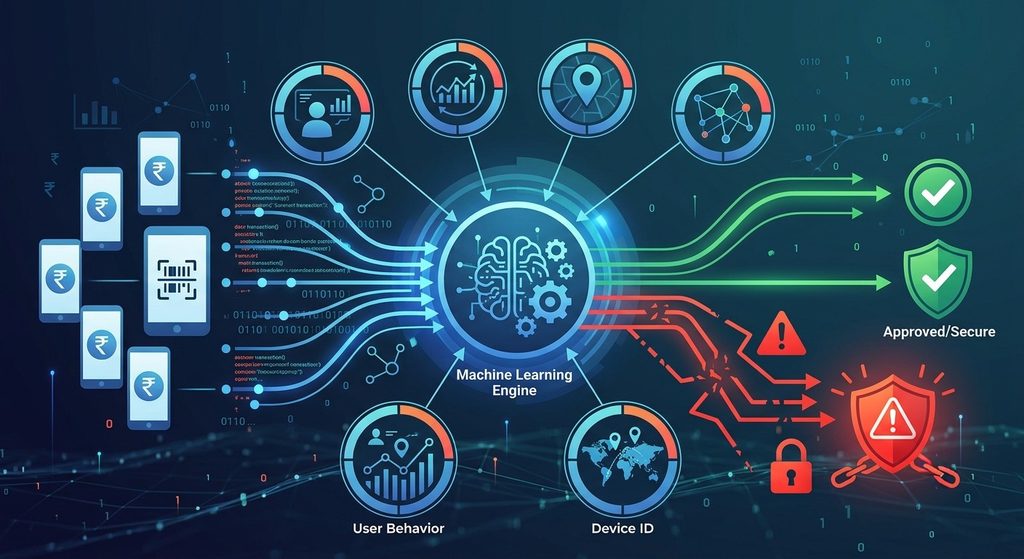
- Behavioral scoring—the application observes that it is accustomed that the user pays a certain grocery shop, but all of a sudden a transfer of ₹40,000 goes to a recipient that has never used the service before in the middle of the night.
- Device and location signals—an account access from a different device at a different location before any big transaction takes place.
- Speed checks—many transactions made within a short interval of time is a sure indicator that the money is being drained very quickly from the customer’s account.
- Network analytics—some systems look for the patterns of relations between different accounts trying to identify a fraud scheme, not just targeting something suspicious.
All of the above does not indicate fraudulent behavior by itself. But machine learning algorithm processes many signals and generates the risks’ score in seconds or even faster than a group of people could do.
How Can This Information Benefit You as a User (or a Business)
If you are a frequent user of UPI, the practical take-home message is straightforward: the so-called notifications about “unsuspicious activity” and delays in payments are not caused by your bank. In most cases, they are consequences of the operation of a machine-learning model.
For those developing or working for any fintech venture, this information is also very valuable:
- Straightforward fraud prevention procedures are insufficient
- The hybrid approach (rules + machine learning + anomaly detection methods) gives the best results
- Rather than focus on accuracy of the model, it is more important to minimize false alarm cases — a disappointed genuine user undermines your reputation as much as a fraud case
- Fraud patterns are changing all the time, which means that models require constant training, rather than a “set-and-forget” approach
The Future Ahead
Fraud detection is a tricky game, and it is always going to be. As scammers become more advanced – using AI technology not just to trick victims, but also for writing more convincing phishing messages, for instance – fraud detection mechanisms should adapt continually.
The next trend might probably be focused more on real-time graph analysis (detecting not just single transactions, but also whole fraud rings) as well as closer interaction between banks, UPI applications, and telecommunication companies.
Yet, the encouraging news is that every time you receive an alert that says “this transaction looks unusual” there is an automatic and continuously learning system functioning in the background to prevent theft.
Have ever had a UPI transactions that were flagged or blocked unexpectedly? Please share your story in the comments – it may help someone to avoid being scammed.